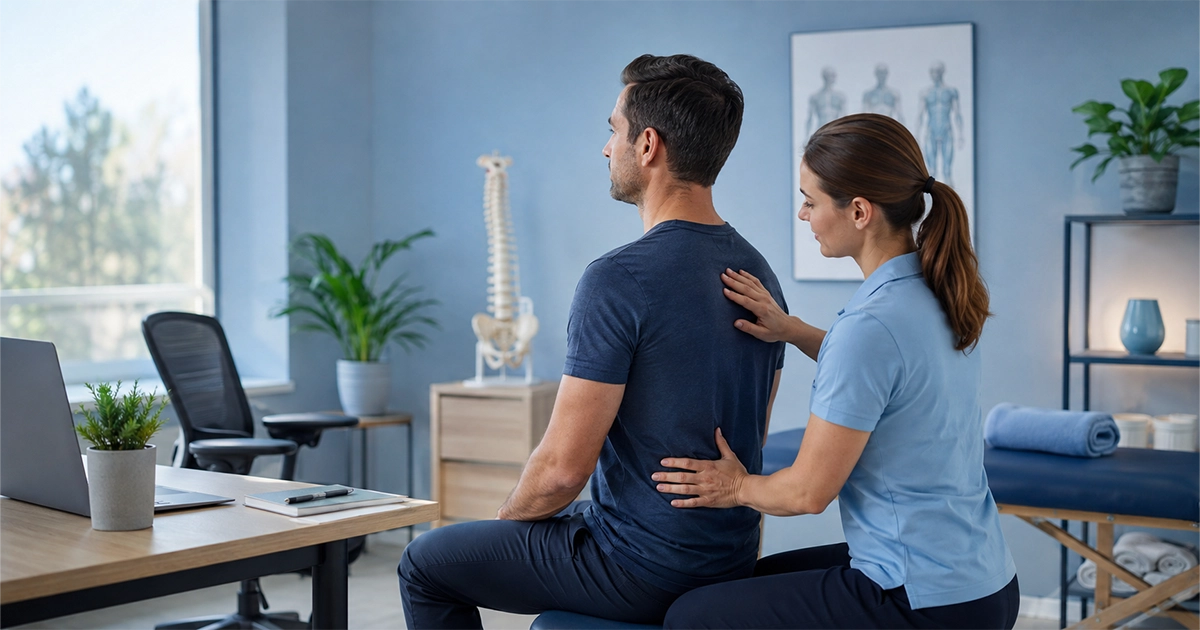
Osteopathy may support desk-related posture strain by using gentle manual techniques that consider muscles, joints, connective tissues, breathing patterns, movement habits, and areas of stiffness. It should not be presented as posture correction, spinal realignment, or a guaranteed solution. Care depends on assessment, comfort, health history, and symptoms.
If you spend most of your working day at a desk and feel the familiar tightness settling into your upper back by mid-afternoon, or the stiffness in your neck that makes turning your head feel like more effort than it should, you are navigating one of the most common physical patterns in modern work life.
Desk-related posture strain is not a single injury. It is an accumulation of mechanical load, static positioning, and movement reduction that builds gradually, often without a clear starting point and rarely with a specific moment of injury to point to. It tends to be dismissed as the background noise of a desk-based lifestyle until it becomes consistent enough to affect concentration, sleep, or the simple pleasure of moving without discomfort.
This blog explains what posture-related strain from desk work tends to feel like, how osteopathic manual care may support it, how it compares to other manual therapy options, and what an appointment at Innova Integrated Wellness Centre in Mississauga involves for patients presenting with these patterns.
What Posture-Related Strain Can Feel Like
Desk-related posture strain rarely announces itself with dramatic pain. It more typically arrives as a collection of smaller, persistent physical experiences that individually seem manageable but collectively represent a meaningful change in how the body feels and moves.
- Upper back tension. A consistent ache or heaviness between the shoulder blades, often worse by mid- to late afternoon, that may ease briefly with movement but returns predictably with sustained sitting. Many people describe this as a feeling of muscles that are working harder than they should to hold the body upright.
- Neck stiffness and restricted movement. Difficulty rotating the head fully to one side, discomfort when looking up or down, or a general sense of reduced ease in neck movement. This often accompanies or follows upper back tension rather than appearing alone.
- Tension headaches. Headaches that begin at the base of the skull and may travel forward over the top of the head, typically intensifying through the day and easing with rest. These are often associated with sustained upper neck and suboccipital muscle tension from forward head positioning.
- Breathing that feels shallow or restricted. Sustained thoracic rounding from prolonged sitting compresses the anterior thorax and can reduce the ease and depth of breathing over the course of the day. Many desk workers describe noticing that they are not breathing as deeply at their desk as they are away from it.
- Hip and lower back stiffness. Prolonged hip flexion in a seated position shortens the iliopsoas and hip flexors, which places altered load through the lumbar spine and can contribute to lower back tightness that feels particularly pronounced when first standing after a long sitting period.
The Innova article on osteopathy for back stiffness and mobility addresses the broader picture of how these stiffness patterns develop and what osteopathic assessment considers in their management.
How Desk Work May Contribute to Stiffness
Understanding why desk work produces these patterns helps clarify why approaches that address only the immediate site of discomfort often produce only temporary relief.
- Static loading. Sustained positioning places muscles, tendons, and connective tissues under continuous tension rather than the variable loading that movement provides. This sustained tension is more fatiguing and more likely to produce stiffness than the same structures would experience during normal movement variety.
- Forward head position. Desk setups encourage a head position displaced forward of the shoulders. Each centimeter of forward head displacement meaningfully increases effective cervical spine load, a pattern that accumulates over hours of daily screen use in the posterior neck muscles, cervical joints, and supporting soft tissues. The Innova article on chiropractic care for desk job back and neck pain covers this pattern in detail.
- Thoracic rounding. A screen positioned at or below eye level and the general comfort of leaning slightly toward a desk tend to encourage thoracic kyphosis, a rounding of the mid-back. This reduces thoracic joint mobility, places the shoulder girdle in a protracted and depressed position, and shortens the anterior chest muscles. The thoracic spine is critical for overall spinal mobility, and restrictions here often contribute to compensatory loading in the cervical and lumbar regions.
- Reduced respiratory movement. Restricted thoracic mobility from sustained forward-compressed posture limits the depth and ease of breathing. Less thoracic movement during respiration also means less natural self-mobilization of the thoracic joints across the working day.
- Cumulative reduction in movement. Screen tasks are characteristically low-movement tasks. The natural variation in position, the loading and unloading of different joint surfaces, and the tissue mobility that normal movement provides are all reduced in proportion to time spent at a desk. According to Health Canada guidance on sedentary behaviour and musculoskeletal health, sedentary time is consistently associated with musculoskeletal discomfort in working adults, independent of the level of physical activity performed outside of work hours.
What Osteopathic Manual Care May Include
Osteopathic manual care for desk-related posture strain involves a whole-body assessment and hands-on treatment that considers not only the symptomatic areas but also the contributing patterns across the entire musculoskeletal and fascial system.
According to the Ontario Association of Osteopathic Manual Practitioners, osteopathic manual practitioners are trained to assess and address patterns of restriction across the musculoskeletal, fascial, and visceral systems through gentle manual techniques. For desk-related presentations, assessment typically reveals interconnected patterns that span the cervical spine, thoracic cage, respiratory diaphragm, and hip flexors, not simply a localized area of tightness.
- Soft tissue techniques. Rhythmic pressure, stretching, and guided passive movement applied to muscles and fascia to reduce chronic tension and improve tissue quality. For desk-related presentations, this commonly involves the posterior cervical muscles, thoracic paraspinals, pectoral region, and hip flexors, the structures most consistently loaded by sustained desk posture.
- Joint mobilization. Slow, controlled passive movement through the range of specific spinal and rib joints to encourage improved mobility and reduce stiffness. This is distinct from high-velocity manipulation; osteopathic mobilization is gentler and sustained and is well-tolerated by patients who may be sensitive to more forceful approaches.
- Fascial and myofascial techniques. Sustained, guided pressure and movement applied to areas of fascial restriction, addressing the connective tissue network that connects muscle groups and organ systems throughout the trunk. For desk-related presentations, fascial restriction often spans from the pectoral region across the anterior thorax into the respiratory diaphragm – a pattern that affects breathing and thoracic mobility simultaneously.
- Respiratory and diaphragm work. Osteopathy specifically addresses the role of the diaphragm and breathing mechanics in thoracic mobility. Guided breathing work and gentle manual attention to the diaphragm and thoracic cage can improve both the depth of breathing and the mobility of the thoracic spine, an approach that addresses both the symptom of restricted upper back movement and one of its perpetuating contributors.
- Craniosacral approaches. For patients whose presentations include headaches or fatigue alongside the posture-related physical pattern, craniosacral techniques may be incorporated. The Innova article on what to expect at your first visit to an osteopath provides a detailed walkthrough of the initial appointment.
Osteopathy vs Chiropractic Care vs Massage Therapy
For patients with desk-related posture strain, three manual therapy options are most commonly considered. Understanding how they differ helps clarify where osteopathy fits within the broader range of available approaches.
| Approach | Primary Focus | Desk Strain Application |
| Osteopathy | Whole-body structure, fascia, joints, organ relationships, breathing | Broad assessment spanning cervical, thoracic, fascial, and respiratory patterns |
| Chiropractic Care | Spinal and peripheral joint mechanics, nervous system | Specific joint restrictions, cervical and thoracic mobility, neurological screening |
| Registered Massage Therapy | Soft tissue, muscle tension, circulation | Direct release of chronically tense muscles in neck, upper back, and shoulders |
Osteopathy tends to be most appropriate when the presenting pattern is diffuse, involves multiple regions simultaneously, or when the contributing factors include thoracic, respiratory, or fascial dimensions alongside the muscular and joint components. The Innova article on osteopathy vs chiropractic care provides a detailed comparison for patients considering both options.
For desk-related presentations with significant muscular tension in the upper trapezius, levator scapulae, and suboccipital muscles, registered massage therapy for neck and shoulder tension may be a valuable complement to osteopathic care or an appropriate starting point depending on the nature of the presentation.
At Innova, all three disciplines are available under one roof and coordinate directly.
Movement Habits Between Appointments
Manual therapy for desk-related posture strain produces better and more durable outcomes when supported by changes to the daily patterns that contribute to the problem. Your osteopathic practitioner will provide personalized guidance, but the following principles apply broadly.
- Frequency of position change. Changing position, standing, walking briefly, stretching – every 45 to 60 minutes reduces cumulative loading on the cervical and thoracic structures more meaningfully than any static posture adjustment. The Innova office ergonomics and workstation setup guide provides practical guidance on desk setup that supports this habit.
- Thoracic extension movement. A brief thoracic extension over a chair back or foam roller counteracts the thoracic flexion that accumulates during a desk day. One to two minutes midday can meaningfully reduce the end-of-day upper back tension most desk workers experience.
- Breathing awareness. Periodically taking full breaths, allowing the rib cage to expand laterally and posteriorly, provides gentle thoracic mobilization alongside the physiological benefits of deeper respiration.
- Shoulder blade retraction. Gently drawing the shoulder blades down and back from the protracted position desk work encourages reduced anterior chest shortening and upper trapezius overactivation.
When Posture-Related Pain Needs Medical Assessment
Most desk-related posture strain is appropriate for osteopathic assessment and care without requiring medical evaluation first. The following signs indicate that medical assessment should take priority.
Any neurological symptom, numbness, tingling, or weakness in the arms or hands, associated with neck or upper back symptoms requires investigation to rule out nerve root compression or more serious spinal pathology before manual therapy proceeds.
Severe or rapidly worsening pain that does not follow the typical pattern of desk-related strain, improving with movement and worsening with sustained positions, may have a different underlying cause that needs medical review.
Any neck or upper back pain following significant trauma, fall, or impact warrants medical assessment rather than manual therapy as the first response.
Upper back pain accompanied by fever, unexplained weight loss, or night sweats should be medically investigated. These red-flag signs are rare in desk-related presentations but require exclusion when present.
Pain that has been consistently worsening over a short period without a clear mechanical explanation is always worth discussing with a physician before proceeding with manual therapy. A responsible osteopathic practitioner will screen for these presentations at intake and recommend appropriate referral when indicated.
Osteopathy Support at Innova in Mississauga
At Innova Integrated Wellness Centre in Mississauga, osteopathy is delivered within an integrated clinical environment that also includes chiropractic care, physiotherapy, and registered massage therapy. For desk-related posture strain, a presentation that frequently involves both joint and soft tissue components, having all three disciplines available and communicating within the same clinic means the care plan can be aligned to your specific pattern rather than limited to what a single discipline addresses.
Every osteopathic appointment begins with a thorough assessment rather than a generic treatment protocol. Your practitioner will explain what they find and what they propose to address and will check in throughout the session about your comfort. No technique is applied without your understanding and consent.
The Innova blog on why more patients are choosing osteopathic treatment in 2025 and osteopathic treatment for movement concerns provides useful broader context. Most extended health benefit plans that include osteopathy or manual therapy coverage apply. No physician referral is required.
Conclusion
Desk-related posture strain often develops gradually through prolonged sitting, reduced movement, repetitive screen use, and sustained loading of the neck, upper back, shoulders, and hips. While osteopathy should not be viewed as a way to permanently “correct” posture or realign the spine, it may support people experiencing stiffness, tension, and reduced mobility by addressing relevant joint, soft tissue, fascial, and breathing-related patterns as part of an individualized assessment.
For lasting improvement, hands-on care is usually most useful when combined with practical changes such as more frequent movement, better workstation habits, thoracic mobility, and greater awareness of breathing and positioning throughout the workday.
If desk-related tension or stiffness is beginning to interfere with your comfort, movement, or daily routine, an osteopathic assessment can help determine whether manual care is appropriate for your presentation. At Innova Integrated Wellness Centre in Mississauga, care begins with a thorough assessment and is tailored to your symptoms, health history, comfort, and goals.
Book your osteopathy assessment at Innova Integrated Wellness Centre in Mississauga.
Book an Appointment Online | Call: (905) 814-9355 | 49 Queen Street South, Unit 8, Mississauga, ON
Frequently Asked Questions
Osteopathy may help by assessing the patterns of joint restriction, fascial tension, and breathing mechanics that develop through sustained desk posture and addressing them through gentle manual techniques. It does not correct posture or realign the spine in any permanent structural sense. Results vary depending on chronicity, the number of contributing factors, and how consistently daily movement habits can be modified alongside treatment. A proper assessment establishes what is appropriate for your specific presentation.
Chiropractic care focuses primarily on specific spinal and peripheral joint mechanics, with manipulation or mobilization as the primary technique. Osteopathy takes a broader whole-body view that additionally addresses fascial patterns, thoracic cage and breathing mechanics, and visceral relationships, dimensions that may contribute to desk-related posture strain but are not within the primary scope of chiropractic care. For many patients, the two approaches complement each other. Both are available at Innova and can be coordinated.
Both may support upper back tension, addressing different layers of the same problem. Registered massage therapy directly addresses the muscular tension in the upper trapezius, levator scapulae, and suboccipital muscles through soft tissue techniques. Osteopathy addresses these tissues alongside the underlying joint mobility, fascial patterns, and thoracic breathing mechanics that contribute to why those muscles remain chronically overloaded. For many desk workers, the most effective approach combines both massage therapy for immediate soft tissue relief and osteopathy for the broader structural and fascial pattern.
This depends on how long the pattern has been present, how many contributing factors are involved, and how the individual responds to care. Recent-onset presentations with clear contributing factors may respond within four to six sessions. Longer-standing patterns with multiple contributing factors typically require a longer program. Your practitioner outlines a recommended approach at the first appointment and reassesses at defined milestones rather than continuing indefinitely without reviewing progress.
Some extended health benefit plans in Ontario include osteopathy or manual therapy as a covered category. Coverage and requirements vary significantly between plans. Contact your insurer directly to confirm whether osteopathy is included and what the annual limit and practitioner credential requirements are. Innova’s administrative team can assist with insurance questions before your appointment. No physician referral is required to book.