Most people with diabetes understand that blood sugar management matters. Fewer realize that what happens to their feet is one of the clearest indicators of how well that management is working and one of the most consequential areas to get wrong.
Diabetes can cause nerve damage, also known as diabetic peripheral neuropathy, and poor blood flow or circulation to the legs and feet, also known as peripheral arterial disease. As a result, people with diabetes are less likely to feel a foot injury such as a blister or cut, and diabetes can make these injuries more difficult to heal. Unnoticed and untreated, even small foot injuries can quickly become infected, potentially leading to serious complications.
At Innova Integrated Wellness in Mississauga, our registered chiropodist Neal Andrews works with diabetic patients to protect foot health through regular clinical assessment, skilled treatment, and practical education. This guide covers why diabetic foot care matters, what to expect from a professional foot check, and how chiropody fits into your broader diabetes management plan.
Why Diabetes Affects Foot Health
Diabetes does not damage the feet in one dramatic event. It does so gradually, through two compounding physiological processes that are often well advanced before a person is aware of them.
Peripheral Neuropathy: Losing the Warning System
Sustained high blood glucose levels damage the small blood vessels that supply the peripheral nerves, particularly in the feet and lower legs. As these nerves lose their blood supply, they lose function. The result is diabetic peripheral neuropathy: a progressive reduction in sensation that typically begins with tingling or burning and can advance to significant numbness.
The clinical consequence of this numbness is serious. Pain is the body’s primary warning system for tissue damage. When that warning system is compromised, a person with diabetes may walk on a blister, a small cut, or a foreign object embedded in the skin for hours or days without knowing it. By the time a wound becomes visible or causes discomfort, it may already be infected.
Peripheral Arterial Disease: Slowing the Healing Response
The second major pathway through which diabetes affects the feet is vascular. High blood glucose damages the walls of blood vessels, reducing their elasticity and promoting the buildup of plaque. In the legs and feet, this produces peripheral arterial disease (PAD), a condition in which blood flow to the lower extremities is progressively reduced.
Adequate circulation is what delivers oxygen, nutrients, and immune cells to injured tissue. When circulation is poor, even small wounds heal slowly or not at all. In a person with both neuropathy and peripheral arterial disease, a minor skin break can escalate to an ulcer, and an ulcer can escalate to a deep infection with alarming speed.
Among patients with diabetes in Canada, one of the major causes of increased morbidity and mortality includes lower-extremity complications. Patients who have peripheral neuropathy and peripheral arterial disease are at risk of developing foot ulcers and infection, which can lead to lower-extremity amputations. Adults with diabetes in Canada are 20 times more likely to be hospitalized for a nontraumatic lower limb amputation than adults without diabetes.
That statistic is not meant to alarm. It is meant to underline exactly why preventive diabetic foot care is one of the most cost-effective and clinically important things a person with diabetes can do for their long-term health.
What Can Happen When Foot Concerns Are Missed
The progression from unmanaged diabetic foot risk to serious complications follows a well-documented clinical path:
- A minor skin break, blister, or pressure area develops and goes unnoticed due to neuropathy
- Poor circulation slows healing and allows bacteria to gain a foothold
- A superficial wound becomes a deep ulcer, extending to underlying tissue
- Infection spreads into bone (osteomyelitis) or surrounding tissue (cellulitis)
- Hospitalization becomes necessary, and in severe cases, amputation is required to control the spread
This is not an extreme or rare scenario. In a large Canadian study examining foot pathologies in over 5,000 adults with diabetes assessed by chiropodists in Ontario, sensory neuropathy was reported in 16.7% of those with Type 1 diabetes and 26.6% of those with Type 2 diabetes, while onychomycosis (fungal nail infection) was present in 14.5% and 28.7%, respectively.
Fungal nail infections, often dismissed as cosmetic, are clinically significant for people with diabetes because they compromise the nail’s structural integrity and create pathways for bacterial infection. A thickened, brittle fungal nail that a person accidentally catches on a sock or bedsheet can cause a skin tear that, under diabetic conditions, becomes a wound that does not heal.
This is the spectrum of risk that professional diabetic foot care in Mississauga is designed to catch and interrupt early.
What a Diabetic Foot Check Includes
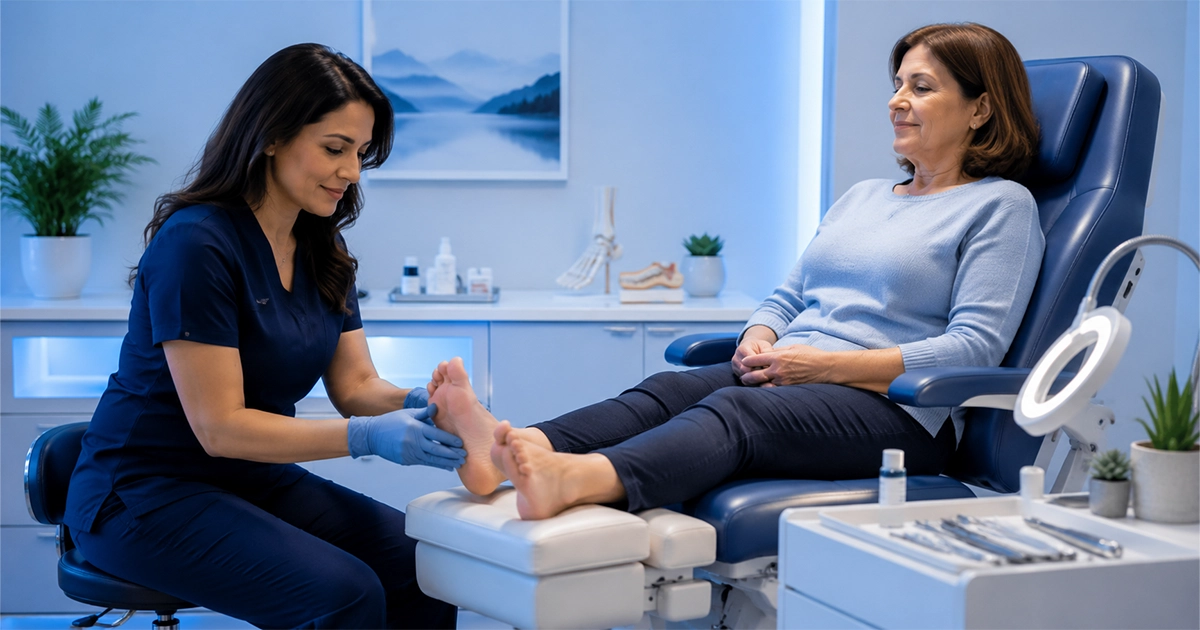
A diabetic foot assessment conducted by a registered chiropodist is a systematic, multi-system clinical examination. It is not a general check of how the feet look. It evaluates every dimension of foot health relevant to diabetic risk.
A chiropodist will perform a foot and lower leg examination covering neurological (nerves), vascular (blood), dermatological (skin), and musculoskeletal (muscles, ligaments, joints, and bones) components. Your chiropodist will teach you how diabetes affects your feet, find out whether you are likely to have serious foot problems, and set up a foot care program for you.
In practice, a comprehensive diabetic foot check at Innova Integrated Wellness includes:
Neurological Assessment
- Monofilament testing to assess protective sensation across specific plantar sites
- Vibration sense testing using a tuning fork to evaluate large fiber nerve function
- Reflex testing to assess nerve pathway integrity in the lower leg
Vascular Assessment
- Palpation of pedal pulses (dorsalis pedis and posterior tibial arteries)
- Capillary refill time assessment
- Skin temperature comparison between feet and lower legs
- Visual assessment of skin color, hair distribution, and tissue quality as indicators of arterial health
Dermatological Assessment
- Inspection of all skin surfaces, including between toes and under the heel
- Assessment of calluses, corns, fissures, blisters, and any areas of skin breakdown
- Nail examination covering thickness, color, curvature, and signs of fungal infection or ingrown edges
- Identification of any current wounds, ulcers, or lesions requiring treatment
Musculoskeletal Assessment
- Evaluation of foot structure and deformity, including bunions, hammer toes, and Charcot foot changes
- Gait analysis for pressure distribution abnormalities
- Footwear assessment to identify shoe fit, heel counter support, and pressure point risk
At the end of the assessment, your chiropodist will assign a risk classification and set the frequency of follow-up visits accordingly.
How Chiropody Helps Protect the Feet
Chiropodists registered with the College of Chiropodists of Ontario are the only regulated foot specialists in Ontario whose legislated scope of practice includes high-risk wound care for people with diabetes. Their clinical interventions for diabetic patients include:
Safe Nail Care
Trimming and filing thickened or fungal nails requires precision that goes beyond standard grooming. For people with diabetes, a nail cut too short, an ingrown edge left unaddressed, or a fungal nail left untreated can initiate the wound cycle described above. A chiropodist performs nail care using sterile instruments and clinical judgment about exactly where the nail ends and where the nail bed begins, minimizing any risk of inadvertent skin trauma.
Callus and Corn Reduction
Calluses are the body’s protective response to repeated pressure or friction. In people without diabetes, they are usually a minor inconvenience. In people with diabetes, a callus concentrates pressure on the underlying skin with every step, eventually causing the skin beneath it to break down and ulcerate.
A chiropodist performs safe, sterile debridement of calluses and corns, removing the pressure concentration without creating new skin disruption. Custom orthotics or padding may also be recommended to redistribute pressure and reduce callus reformation.
Wound Assessment and Management
If a wound is already present, a registered chiropodist can assess its depth, vascular supply, and infection status and provide appropriate wound management or refer to specialist care where required. Early professional management of a diabetic foot wound dramatically improves healing outcomes.
Footwear and Orthotic Guidance
Inappropriate footwear is one of the most common contributors to diabetic foot injury. A chiropodist assesses current footwear and advises on appropriate shoe characteristics for diabetic feet, including adequate toe box depth, supportive heel counters, and protective sole construction. Where biomechanical issues are creating pressure points, custom orthotics may be prescribed and dispensed.
For patients who also need support with gait, mobility, or lower limb function, Neal Andrews coordinates with the physiotherapy team at Innova Integrated Wellness to provide a coordinated approach to foot and lower limb health.
Daily Foot Care Tips for People With Diabetes
Professional chiropody visits are essential, but what happens between appointments matters too. The following daily practices are recommended for people with diabetes:
- Inspect your feet every day. Use a mirror to see the soles and between the toes. Look for any new redness, swelling, blisters, cuts, or areas of skin change. If vision is limited, ask a family member to help.
- Wash your feet daily in warm (not hot) water. Test water temperature with your elbow, not your feet, as neuropathy may prevent you from accurately sensing heat. Dry thoroughly, particularly between the toes.
- Moisturize the entire foot, excluding between the toes. Dry, cracked skin on the heel and sole is a common entry point for infection. Use a fragrance-free moisturizer daily. Avoid applying between the toes, where excess moisture promotes fungal growth.
- Never walk barefoot. Even indoors, a small object on the floor can cause a wound that you will not feel. Wear well-fitting shoes or protective slippers at all times.
- Cut toenails straight across and file the edges. Cutting down the sides of the nail creates the conditions for ingrown edges. If you have difficulty reaching your feet or your nails are thickened, leave nail care to your chiropodist.
- Change socks daily and choose seamless diabetic socks. Seams and tight elastics create pressure points. Diabetic socks are designed to minimize these risks and wick moisture away from the skin.
- Check your shoes before putting them on. Shake them out and run your hand inside to check for foreign objects, rough seams, or debris.
- Never use corn removers, blades, or medicated pads at home. Over-the-counter corn and callus treatments contain acids that can damage the skin of a person with diabetes. Always have these conditions treated professionally.
Good nutrition also plays a role in foot health. Poor glycemic control accelerates nerve damage and vascular disease, and nutrient deficiencies affect skin integrity and wound healing. The nutrition and wellness team at Innova Integrated Wellness can support your dietary management as part of a coordinated diabetes care plan.
When to Book a Chiropody Visit
You should book a chiropody visit if any of the following apply:
- You have a diagnosis of Type 1 or Type 2 diabetes and have not had a professional foot assessment in the past year
- You have noticed any change in sensation in your feet, including tingling, burning, or numbness
- You have calluses, corns, thickened toenails, or fungal nail changes
- You have noticed any skin discoloration, swelling, or unusual warmth in one foot compared to the other
- You have any open skin area, blister, or wound on your feet, no matter how minor it appears
- You have a history of diabetic foot ulcer or previous amputation
- You have been told you have peripheral neuropathy or peripheral arterial disease
- You are finding foot hygiene difficult to maintain independently
Do not wait for pain to appear before seeking care. By definition, neuropathy reduces the pain signal that would ordinarily prompt action.
What Diabetic Foot Care Looks Like at Innova Integrated Wellness
At Innova Integrated Wellness, our chiropodist Neal Andrews brings dedicated clinical expertise to diabetic foot care in Mississauga. Neal conducts thorough diabetic foot assessments, provides ongoing management of nail and skin conditions, and develops individualized foot care programs that reflect each patient’s risk level, lifestyle, and overall health picture.
What makes our approach distinctive is integration. Neal works alongside our physiotherapy, nutrition, and other allied health practitioners to ensure that diabetic foot care does not exist in isolation from the rest of your health management. If gait changes are identified that suggest a need for physiotherapy input, that conversation happens. If dietary patterns are affecting glycemic control and therefore foot healing, that connection is made. This is what whole-person diabetic care looks like in practice.
Our Mississauga clinic serves patients across a range of diabetic foot risk levels, from those seeking their first annual foot assessment to those managing active wounds or post-amputation residual limb care.
You can also learn more about our approach to common foot conditions in our blog on common foot problems a chiropodist in Mississauga can treat, and about long-term foot health in our guide on the role of chiropody in preventing chronic foot problems.
Conclusion: Protect What Carries You
Your feet carry you through every day of your life. For people with diabetes, protecting that capacity requires more than awareness. It requires consistent, professional clinical oversight from a practitioner who understands the specific ways diabetes reshapes foot risk.
Regular chiropody visits with Neal Andrews at Innova Integrated Wellness in Mississauga offer that oversight. Together with good daily home care, appropriate footwear, and integrated management of your overall diabetic health, professional foot care is one of the most impactful investments you can make in your long-term mobility and independence.
Book Your Diabetic Foot Check in Mississauga. Do not wait for symptoms to appear. Book a diabetic foot assessment with Neal Andrews at Innova Integrated Wellness today and take the next step in protecting your foot health. Book Your Chiropody Appointment at Innova Integrated Wellness.
Questions About Diabetic Foot Care in Mississauga
The recommended frequency depends on your individual risk level. People with diabetes who have no active neuropathy, vascular disease, or foot complications should have a comprehensive foot assessment at least once per year. Those with moderate risk factors, such as mild neuropathy or previous minor foot injuries, typically benefit from visits every three to six months. People with high-risk factors, including active ulcers, significant neuropathy, or peripheral arterial disease, may require monthly or more frequent monitoring. Your chiropodist will assign a risk classification at your first assessment and recommend a visit schedule based on your clinical picture.
A comprehensive diabetic foot assessment covers four domains: neurological (sensation and reflex testing), vascular (pulse palpation and circulation indicators), dermatological (skin, nails, calluses, and wounds), and musculoskeletal (foot structure, gait, and footwear). Your chiropodist will also review your diabetes history, current medications, and any changes in symptoms since your last visit. The goal is to identify any new risk factors or early warning signs before they develop into complications.
Yes. Diabetic peripheral neuropathy is one of the most common complications of diabetes, and numbness in the feet is one of its most characteristic features. It typically develops gradually, often beginning with tingling or burning sensations before progressing to reduced sensation or complete numbness in the toes and soles. Because numbness removes the pain signal that normally warns of injury, it significantly increases the risk of unnoticed foot wounds. Regular neurological testing during chiropody visits can track the progression of neuropathy and prompt earlier intervention when changes occur.
Yes, significantly more serious. In people without diabetes, a callus is a minor cosmetic and comfort issue. In people with diabetes, a callus concentrates mechanical pressure on the skin beneath it with every step taken. This sustained pressure eventually causes the skin to break down from the inside, creating an ulcer beneath the hardened surface tissue that may go undetected until it is already significant. Safe, regular debridement of calluses by a registered chiropodist in Mississauga is one of the most effective preventive interventions available for reducing diabetic foot ulcer risk.
Yes, and prevention is the primary purpose of regular diabetic foot care. A chiropodist identifies early risk indicators before they produce symptoms, manages skin and nail conditions that would otherwise become entry points for infection, provides education that reduces home-care errors, and coordinates with other healthcare providers to ensure that systemic factors affecting foot health are addressed. Research and clinical guidelines consistently support regular professional foot care as a key component of diabetes management for reducing the risk of ulceration and amputation.
Any change in the feet warrants prompt attention for a person with diabetes. Specifically, do not ignore: any new wound, blister, or area of skin breakdown no matter how minor; any unusual warmth, redness, or swelling in one foot; any change in skin color including pallor, bluish tinging, or darkening; any new or worsening numbness, tingling, or burning; any increase in pain when walking or at rest (which may indicate arterial insufficiency); and any nail that has become thick, discolored, or painful. If in doubt, call your chiropodist or family physician the same day.
No. A doctor’s referral is not required to make an appointment with a chiropodist. Chiropodists are primary health care providers, so just like a dentist is your first choice for dental health, a chiropodist is your first stop for foot care. Many family physicians do refer their diabetic patients to chiropodists for routine foot care, but you are welcome to book directly with Neal Andrews at Innova Integrated Wellness without a referral. Some extended health insurance plans require a referral for direct billing purposes, so it is worth checking your specific plan before your appointment.
Yes, directly. Nutritional status affects diabetic foot health through multiple pathways. Good glycemic control, supported by appropriate dietary management, directly reduces the rate of nerve damage and vascular disease that drive diabetic foot complications. Specific nutrients also matter: vitamin D supports immune function and skin integrity; zinc supports wound healing; adequate protein intake supports tissue repair. Conversely, nutrient deficiencies common in people with long-standing diabetes, including B12, magnesium, and vitamin D, can worsen neuropathy and impair healing. The nutrition and wellness practitioners at Innova Integrated Wellness can address these dietary factors as part of a coordinated diabetic health plan.